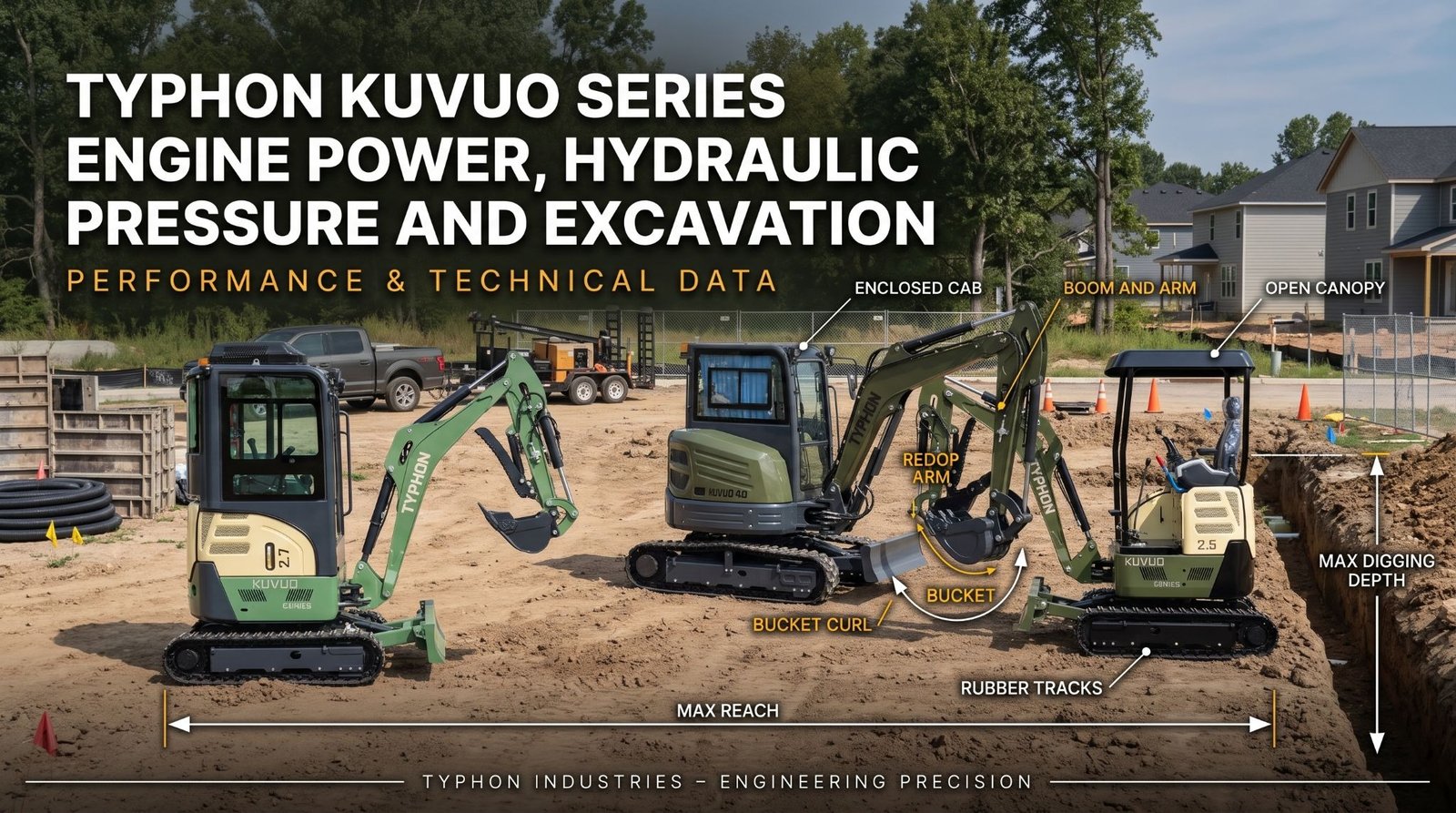
Compact excavator performance depends on how well three systems work together: the engine, the hydraulic system, and the working structure of boom, arm, and bucket. A machine with a capable engine but a poorly matched hydraulic system wastes power as heat. A machine with strong hydraulics but limited reach forces extra repositioning. On residential lots, utility runs, landscaping projects, and foundation work, these differences affect how much work gets done each day.
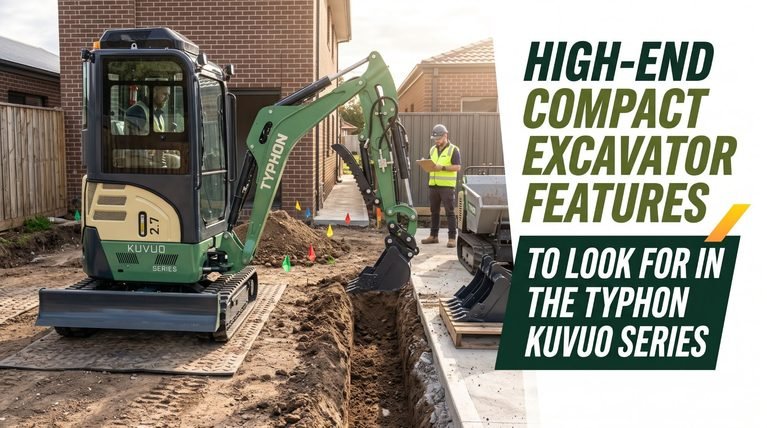
The TYPHON KUVUO Series is built for buyers who need compact dimensions and features suited to demanding excavation work. The series includes the KUVUO 2.7 and the larger KUVUO 4.0. Each model has its own engine, hydraulic configuration, and working range. Looking at engine power, hydraulic pressure, and digging geometry together shows what each machine can actually accomplish on your jobsite.
Engine Power and Excavation Workload
Engine power supplies the energy that runs the excavator’s hydraulic pump and supporting systems. The engine doesn’t move the bucket directly. It turns the pump, and the pump sends pressurized oil to the cylinders and motors that drive the boom, arm, bucket, swing, travel, and blade. Every digging cycle starts with engine output and reaches the ground through the hydraulic system.
The KUVUO 2.7 uses a Kubota D1105 diesel engine. The D1105 is a three-cylinder, liquid-cooled diesel with a displacement of approximately 1.1 liters. It’s widely used in compact construction and industrial equipment, and it’s known for smooth running and established service procedures. Its compact size suits a machine where installation space is limited.
The larger KUVUO 4.0 uses a Kubota D1703. This is also a three-cylinder, liquid-cooled diesel, with greater displacement of approximately 1.6 liters. The added displacement supports a larger machine with heavier working demands. These two engines serve different configurations, so their ratings shouldn’t be treated as interchangeable when comparing the models.
Engine output also depends on condition and environment. Hot weather, high altitude, a restricted air filter, contaminated fuel, or a clogged radiator can all reduce the power the engine actually delivers. Confirm the exact horsepower, rated speed, and emissions configuration for each model on the engine identification label and the TYPHON specification sheet. Run the engine at the working speed the manual recommends for digging, and allow a full warm-up before heavy work in cold weather.
Key takeaway: The KUVUO 2.7 runs on a Kubota D1105 and the KUVUO 4.0 on a Kubota D1703, so confirm each engine’s exact rating on the specification sheet and keep it in good condition, since engine output reaches the bucket only through the hydraulic system.
Variable-Displacement Piston Pump Technology
The KUVUO 2.7 is specified with a variable-displacement axial piston pump. In this design, pistons are arranged in a rotating cylinder block, and an angled plate called a swashplate controls how far they travel. Changing the swashplate angle changes how much oil the pump delivers per revolution. The pump can supply more flow when functions demand it and less when they don’t, even while the engine runs at a steady speed.
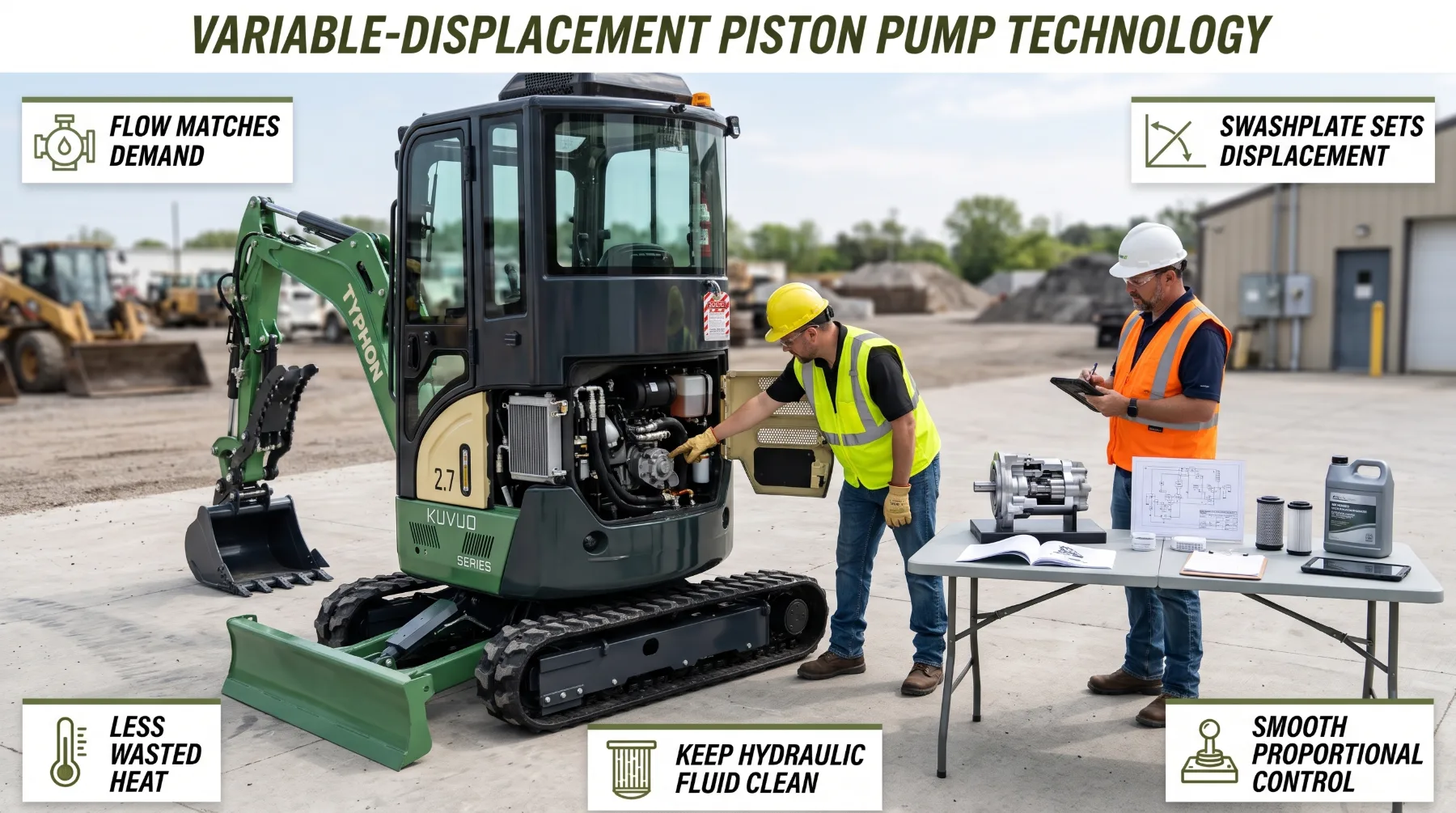
That ability matters on an excavator because different tasks need different combinations of flow and pressure. Swinging an empty bucket calls for speed with little force. Prying into compacted clay calls for high force at slower speed. Running boom, arm, and swing together calls for more total flow. A variable-displacement pump adjusts its output to match these changing demands.
The practical benefits show up throughout the workday. When the operator meters a function slowly for grading or setting pipe, the pump reduces output instead of pushing extra oil across a relief valve. That reduces wasted energy and heat, which helps protect the hydraulic oil and seals. Many piston pump systems also include power or torque limiting, which reduces pump output as pressure rises so the pump doesn’t stall the engine during heavy digging.
Pump technology should still be judged as part of the whole system. Valve design, hydraulic circuit layout, hose sizing, relief settings, and engine output all influence results. Pump condition matters as much as design. Contamination wears internal clearances and reduces output, so use the specified hydraulic fluid, change filters on schedule, and keep the oil cooler clean. If functions slow, whine, or lose power, have a qualified technician test flow and pressure at the manufacturer’s test points.
Key takeaway: The KUVUO 2.7’s variable-displacement axial piston pump adjusts flow to demand, which supports smooth control and less wasted heat, but its performance depends on clean fluid, good maintenance, and the full hydraulic system around it.
Hydraulic Pressure and Working Force
Hydraulic pressure acts on the face of each cylinder piston to create force. The basic relationship is simple: force equals pressure multiplied by piston area. A larger cylinder produces more force at the same pressure. That force powers boom lifting, arm digging, and bucket curling, and it’s the foundation of the machine’s breakout and digging force.
Pressure alone doesn’t establish excavation capability. Linkage geometry decides how much cylinder force becomes useful force at the bucket teeth. Hydraulic flow sets how quickly cylinders move. Machine weight and stability decide whether the excavator can apply that force without lifting or sliding. Two machines with similar pressure ratings can dig very differently because of these factors.
Operators protect the system by working within its design. Avoid holding a cylinder at the end of its stroke, since that sends oil over the relief valve and turns engine power into heat. Don’t slam the bucket into hard ground or use it as a hammer. Never raise relief valve settings to gain extra force. Higher pressure can burst hoses, damage seals, crack welds, and overload pins and the boom structure. Leave pressure testing and adjustment to qualified technicians using calibrated gauges.
Pressurized oil also demands careful inspection habits. Never use your hand to search for a hydraulic leak around cylinders, hoses, or fittings. Fluid escaping through a pinhole under pressure can penetrate skin and cause an injection injury. The wound may look like a minor puncture at first, but it’s a medical emergency that requires immediate surgical treatment. Hold a piece of cardboard or wood near the suspected leak point, wear gloves and eye protection, and keep your face and body out of line with the fitting. If anyone is struck by escaping fluid, get emergency medical care at once and tell medical staff it’s a hydraulic injection injury.
Key takeaway: Hydraulic pressure creates cylinder force, but digging capability also depends on cylinder size, linkage geometry, flow, and stability, so never raise relief settings and always check leaks with cardboard rather than your hands.
Digging Depth, Reach, and Working Geometry
Digging depth and reach determine which areas an excavator can work from a single position. The KUVUO 2.7 has a specified digging depth of 6.07 feet and a reach of 9.94 feet. These figures help buyers plan trenching, foundation preparation, drainage work, and general excavation. A machine that reaches the full depth and width of the job from one setup spends less time repositioning and leaves fewer track marks on the site.
Working geometry affects more than maximum figures. Boom length, arm length, and pivot positions shape how the bucket moves through its arc, how much force is available at different depths, and how close the machine can work to its own tracks. Digging force typically varies across the working range, so a machine may dig more strongly at mid-depth than at full reach. The working range diagram on the specification sheet shows these relationships clearly.
Compare the published figures with your typical jobs. Utility trenches, footings, and drainage runs each have their own depth requirements. A machine that regularly works at its maximum depth leaves no margin for uneven ground or unexpected conditions. Also consider dump height if you load trucks or trailers, and confirm whether the bucket can clear the side rails cleanly.
The larger KUVUO 4.0 is designed as a higher-capacity counterpart to the 2.7. Its exact digging depth, reach, and dump height should be checked on its own specification sheet rather than estimated from the smaller model. Wherever you dig, follow OSHA excavation rules. Contact the local one-call utility locating service, often by dialing 811, before digging. Keep spoil at least 2 feet back from the trench edge, and never allow workers into an unprotected trench 5 feet deep or more unless it’s made entirely in stable rock.
Key takeaway: The KUVUO 2.7 offers 6.07 feet of digging depth and 9.94 feet of reach, so compare those figures and the working range diagram with your real job depths, and confirm the KUVUO 4.0’s geometry on its own specification sheet.
Operator Controls and Cab Features
Operator controls decide how precisely the machine responds during repetitive excavation work. The KUVUO 2.7 is specified with full pilot joystick controls. In a pilot system, moving a joystick sends a low-pressure hydraulic signal that shifts the main control valve spool. The farther the joystick moves, the farther the spool shifts, which gives proportional control. Small movements produce slow, precise motion, and full deflection produces full speed.
Pilot controls generally require less effort than direct mechanical levers. That reduces hand and forearm fatigue over a long shift and helps operators stay accurate late in the day. Smooth, proportional response supports tasks such as finish grading, setting pipe, and exposing utilities. Before every shift, confirm the control pattern shown on the cab decal matches the machine’s actual setting, and test each function slowly in a clear area.
The pilot system includes an important safety device. Most machines use a pilot control lockout, a lever or console that must be lowered before the joysticks work. Raising it cuts pilot pressure so an accidental bump can’t move the machine. Always lower the attachment to the ground and raise the lockout before leaving the seat or letting anyone approach. Remember that stored accumulator pressure may still move a function after shutdown until pressure is relieved as the manual directs.
The KUVUO 2.7’s enclosed cab configuration includes heating and air conditioning. A climate-controlled cab protects the operator from heat, cold, rain, and dust, which supports concentration and comfort on long jobs. Buyers should verify which control and cab features are included in the exact model and package they plan to purchase, since configurations can differ across the series. Wear the seat belt whenever the engine runs, since the operator protective structure works only for an operator who stays inside it.
Key takeaway: The KUVUO 2.7’s full pilot joystick controls and enclosed cab with heating and air conditioning support precise, comfortable work, so confirm the control pattern before every shift, use the pilot lockout, and verify the features included in your exact package.
Matching KUVUO Performance to Job Requirements
Choosing between KUVUO models starts with the work you do most often. Residential excavation, landscaping, utility trenching, and foundation preparation each place different demands on a compact excavator. A landscaper working through garden gates may value the smaller machine’s compact size. A contractor digging deeper footings or loading trucks regularly may benefit from the larger model’s capacity.
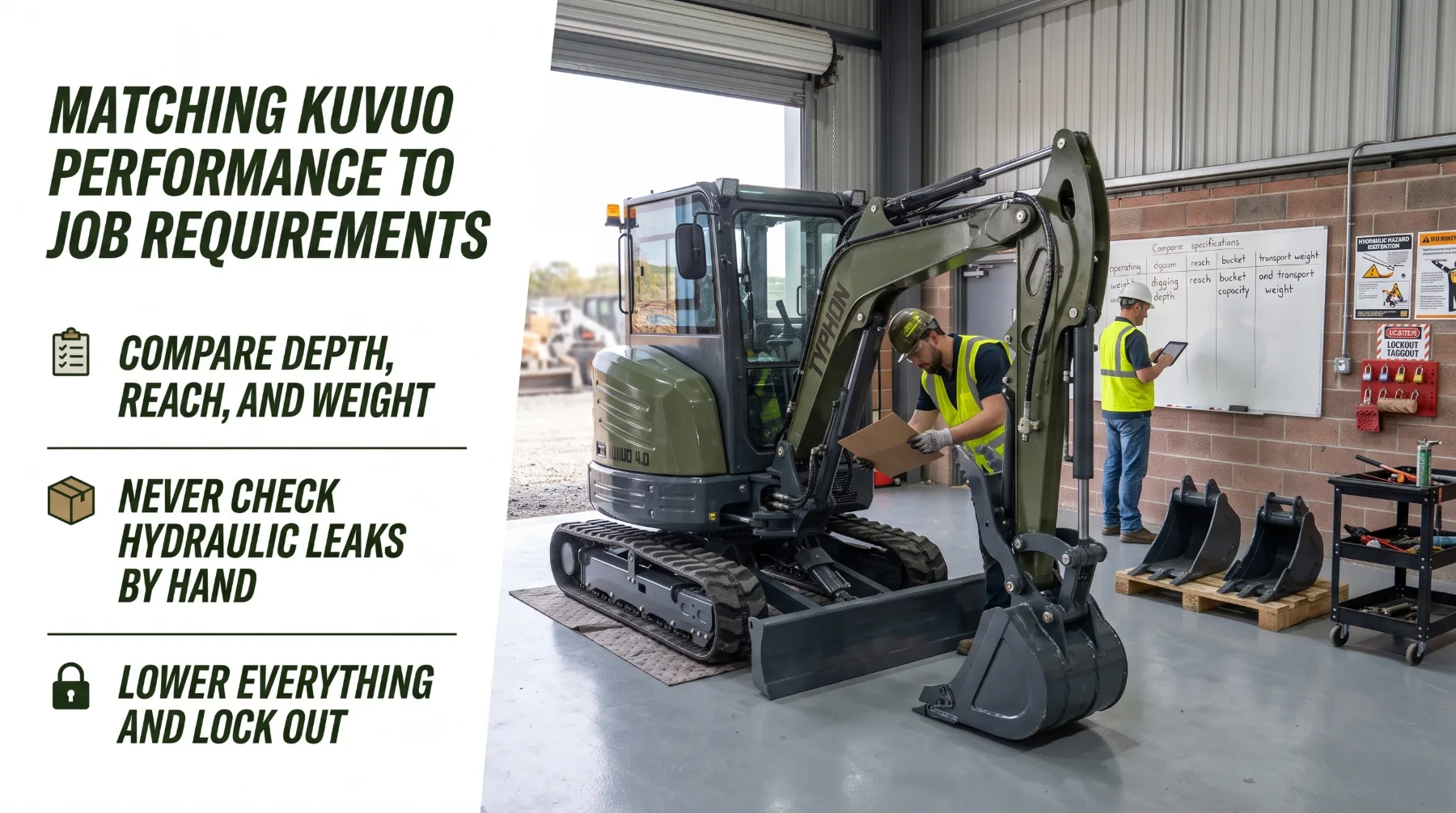
Compare the complete specification set rather than a single figure. Review operating weight, digging depth, reach, dump height, bucket capacity, track dimensions, and hydraulic specifications side by side. Check transport weight against your trailer and towing vehicle ratings. Confirm attachment compatibility for buckets, thumbs, augers, or breakers you plan to run, along with auxiliary hydraulic flow and pressure. Ask about service access, parts availability for both the Kubota engine and TYPHON components, and local dealer support.
Daily inspection keeps that performance consistent. Before each shift, check engine oil, coolant, and hydraulic fluid levels, the air filter restriction indicator, and the radiator and oil cooler for debris. Inspect hoses, cylinders, pins, tracks, and the bucket for leaks, wear, or damage, and test the seat belt, horn, lights, and pilot lockout. Report any slow function, unusual noise, or warning light before work continues.
Key takeaway: Match the KUVUO model to your real jobs by comparing verified depth, reach, weight, hydraulic specifications, transport needs, and attachment compatibility, then protect that performance with daily inspection and the full 9-step lockout before any service.
Conclusion
The TYPHON KUVUO Series combines Kubota diesel power with hydraulic systems built for compact excavation work. The KUVUO 2.7 pairs a Kubota D1105 with a variable-displacement axial piston pump, full pilot joystick controls, an enclosed cab with heating and air conditioning, and 6.07 feet of digging depth with 9.94 feet of reach. The KUVUO 4.0 uses a Kubota D1703 for higher-capacity work, and its specifications should be reviewed on their own. Across both models, real excavation performance comes from engine output, pump design, hydraulic pressure, and working geometry working together. Before you buy or rent, compare each model’s verified specifications with the depths, materials, and site conditions you handle most. With the right model, trained operators, and disciplined maintenance, a KUVUO excavator delivers dependable, productive digging on every project.
Frequently Asked Questions
Which engine is used in the KUVUO 2.7?
The KUVUO 2.7 uses a Kubota D1105, a three-cylinder, liquid-cooled diesel engine with a displacement of approximately 1.1 liters. Confirm its exact rating and emissions configuration on the engine label and TYPHON specification sheet.
Which engine is used in the KUVUO 4.0?
The KUVUO 4.0 uses a Kubota D1703, a three-cylinder, liquid-cooled diesel with greater displacement than the D1105. It supports the larger machine’s higher-capacity configuration, so review its ratings on the KUVUO 4.0 specification sheet.
What is the benefit of a variable-displacement axial piston pump?
It adjusts its displacement to supply hydraulic flow according to system demand. That supports smooth, proportional control, reduces wasted energy and heat during slow metering, and helps the machine manage power when several functions run at once.
Does higher hydraulic pressure automatically mean better digging performance?
No. Digging force and overall performance also depend on hydraulic flow, cylinder dimensions, linkage geometry, attachment design, and machine stability. Raising relief pressure beyond approved limits won’t improve digging and can damage hoses, seals, and structural components.