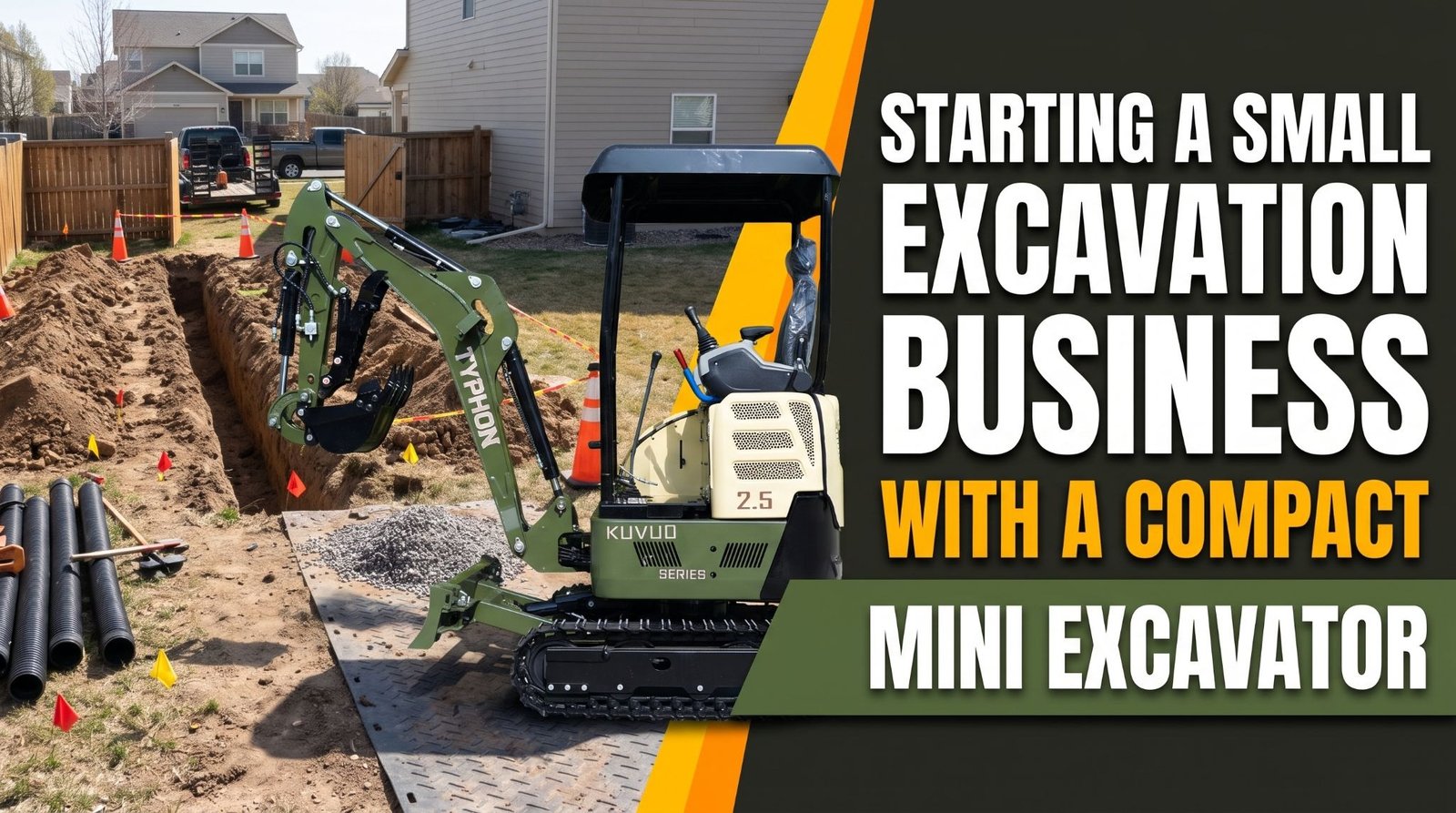
A landscape foreman spends several seasons watching the same pattern repeat across his company’s jobs. Every time a project calls for a drainage trench, a footing for a retaining wall, or a utility line to a backyard shed, the crew either digs by hand for days or waits for a subcontractor who is booked weeks out. Homeowners grow impatient, builders call around for someone faster, and good work slips away.
Eventually he decides to fill that gap himself. He researches compact equipment, buys a well-maintained mini excavator with a matching trailer, and starts offering small excavation services to the builders, landscapers, and homeowners he already knows. His first months are slower than he hoped. Then a plumber refers him for a sewer lateral replacement, a fence contractor books him for a week of post holes, and a property manager hires him to regrade drainage around several rental homes. By the end of his first year, his schedule is full and customers are calling him by name. The machine opened the door, but careful planning, honest pricing, and dependable work built the business.
A compact mini excavator can be a practical entry point for contractors who want to offer excavation services for residential properties, landscaping projects, and small construction jobs. Its smaller size lets it reach backyards, side yards, and tight lots where larger excavators can’t work efficiently. Starting an excavation business takes more than buying a machine, though. Owners must understand local demand, choose work that suits the equipment, budget for ownership and operating costs, plan transport, price jobs accurately, and meet safety and insurance requirements. This article covers each of those areas so new business owners can build a sustainable operation from the start. The equipment manufacturer’s operator’s manual, local licensing and permit rules, and applicable regulations, including OSHA excavation standards, remain the primary reference for every machine and job.
Market Demand and Suitable Service Areas
Every successful excavation business starts with a clear picture of local demand. Before buying equipment, spend time learning what kind of digging work your area needs and who is already providing it. Residential construction, home additions, landscaping, drainage correction, fencing, utility connections, septic work, pool installation support, and general property improvement all create steady demand for small excavation services. The mix varies widely between regions, so the services that sell well in a growing suburb may differ from those that sell well in a rural farming community or an older city neighborhood.
Research turns assumptions into a plan. Look at local building permit activity, new subdivision development, and the number of landscaping and home improvement companies working nearby. Talk with builders, plumbers, electricians, fence installers, and landscapers about the excavation work they subcontract and how hard it is to schedule. Review online listings and ask around about competing providers, their pricing, their reputation, and how far out they’re booked. Long wait times often signal an opportunity for a new operator who can respond quickly.
Narrowing your focus helps you stand out. Many small excavation businesses do best when they specialize in a few services they can deliver consistently well, such as drainage solutions, landscape preparation, utility trenching, or small foundation and footing work. A clear specialty makes marketing easier, helps you choose the right attachments, and builds a reputation customers remember. You can expand into related services as the business grows and demand becomes clearer.
Seasonal patterns deserve attention as well. In many areas, ground conditions, weather, and construction schedules create busy and slow periods. Planning for slower months, whether through snow removal, demolition cleanup, site maintenance contracts, or work in a nearby market, helps keep cash flow steady throughout the year.
Key takeaway: Research local building activity, talk with trades that subcontract digging work, and focus on a few in-demand services you can deliver well before committing to equipment.
Equipment Size and Job Selection
The right mini excavator depends on the work you plan to offer most often. Compact excavators come in a wide range of sizes, and each size class brings trade-offs in digging depth, reach, lifting capability, transport weight, and site access. A smaller machine fits through garden gates, works close to homes, and moves easily on lighter trailers. A larger compact machine digs deeper, lifts more, and handles heavier soil with greater productivity, but it requires more transport capacity and wider access.
Match the machine to the jobs you expect to win. If most of your work involves backyard drainage, landscaping, and shallow utility trenches, a smaller model with good maneuverability may serve you well. If you expect footing excavation, sewer and water connections, or heavier site preparation, a larger compact machine may be the better investment. Compare digging depth, reach, dump height, operating weight, overall width, tail swing design, and auxiliary hydraulic capability against the measurements and conditions of your typical jobs. Zero-tail-swing and reduced-tail-swing designs are especially useful when working next to buildings, fences, and property lines.
Attachments expand what a single machine can do. A selection of digging buckets, a grading or ditch-cleaning bucket, a hydraulic thumb, an auger, and a breaker or ripper tooth can open the door to many more services. Confirm that each attachment is approved for the machine and that the auxiliary hydraulic flow, pressure, and coupler setup match the attachment’s requirements. A quick coupler can save time on jobs that require frequent attachment changes.
Job selection protects both the business and the machine. Avoid accepting work that exceeds the excavator’s rated digging depth, lifting capacity, or stability limits, or that calls for conditions the machine wasn’t designed to handle. Deep excavations, large rock removal, steep slopes, and heavy lifting near structures may require larger equipment, specialized expertise, or engineered protective systems. Knowing when to decline a job, refer it to a partner, or rent additional equipment is a sign of a professional operation.
Key takeaway: Choose a mini excavator and attachments that match your most common jobs, compare digging depth, reach, weight, and access carefully, and decline work that exceeds the machine’s rated capability.
Startup Costs and Operating Expenses
A realistic budget is one of the strongest foundations a new excavation business can have. Startup costs reach well beyond the price of the excavator itself. Owners typically need a suitable trailer, a tow vehicle rated for the combined load, a starter set of buckets and attachments, hand tools, safety equipment, and basic maintenance supplies. Business setup adds costs for registration, licensing, insurance, accounting, a website, signage, and initial marketing.
Choosing between new and used equipment shapes those startup costs. A new machine offers warranty coverage, current technology, and predictable maintenance, but it requires a larger investment or financing commitment. A used machine lowers the upfront cost, but it should be inspected carefully, ideally by a qualified technician. Review service records, check hour meter readings against visible wear, inspect the undercarriage, pins, bushings, cylinders, and hydraulic hoses, and confirm that the machine operates smoothly in every function. Financing, leasing, and rent-to-own options can help preserve working capital, but compare total costs and terms carefully.
Ongoing expenses continue whether or not the machine is working. Fuel, routine maintenance, wear parts such as bucket teeth and tracks, repairs, insurance premiums, loan payments, storage, trailer upkeep, vehicle costs, and advertising all add up. Disposal fees for excavated soil, concrete, and debris can be significant on some jobs. Owners should also set aside funds for unexpected repairs and for slower periods when weather, seasonality, or scheduling gaps reduce income.
Tracking every expense from the first day helps owners understand their true cost of operating. Record fuel use, maintenance, repairs, transport, and job-specific costs for each project. Over time, that information shows which services are most profitable, how much each hour of machine time really costs, and where spending can be controlled. A trusted accountant or business advisor can help set up bookkeeping, tax planning, and cash flow forecasting that support steady growth.
Key takeaway: Budget for the trailer, tow vehicle, attachments, insurance, and business setup alongside the excavator, track every operating expense from the start, and keep reserves for repairs and slow periods.
Transportation and Jobsite Logistics
Moving a mini excavator safely and legally between jobs is a daily part of running an excavation business. The trailer, tow vehicle, and hitch must all be rated for the combined weight of the excavator, attachments, fuel, and any other equipment carried. Confirm the machine’s transport weight for the exact configuration, including the bucket and any attachments, and compare it with the ratings for the trailer, tow vehicle, and hitch. Depending on the total weight and local regulations, the driver may need a specific license class, and the trailer may need brakes, lights, and registration that meet road requirements.
Loading and securing the excavator require care every time. Load on firm, level ground with the tow vehicle and trailer stable, and keep everyone clear of the ramps and the machine’s path. Drive straight up the ramps slowly with the bucket held low, and avoid steering corrections on the ramps. Once in position, lower the bucket and blade to the trailer deck, shut down the engine, raise the pilot control lockout, and remove the key. Secure the machine at the manufacturer’s designated tie-down points using chains, binders, and hardware with adequate working load limits, as cargo securement rules require. Secure attachments separately, and check every tie-down again after the first stretch of driving.
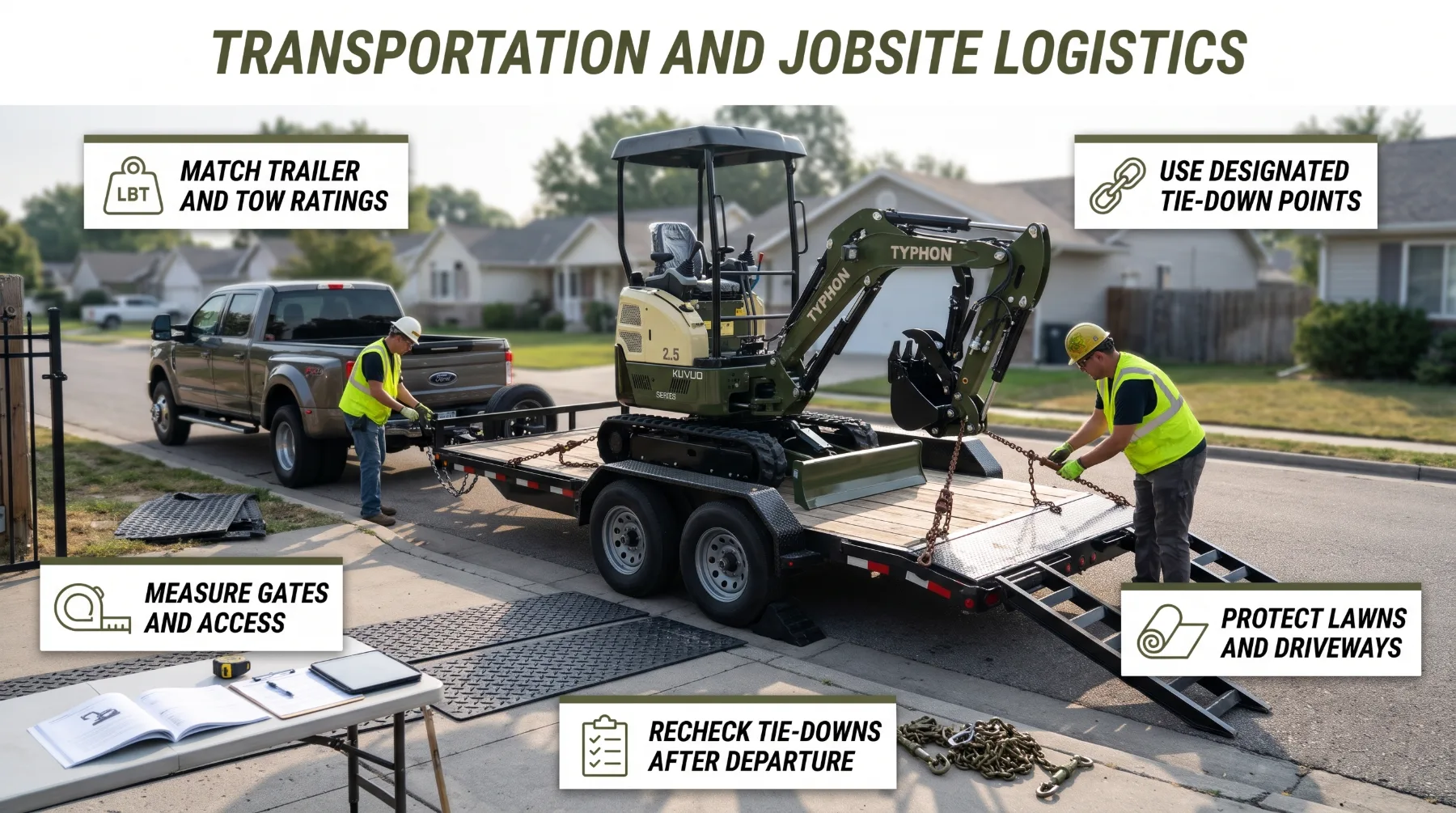
Jobsite logistics begin before the machine arrives. Visit the site or review photos and measurements to confirm access width, overhead clearance, gate openings, slopes, soft ground, and where the trailer can park and unload safely. Identify sprinkler systems, septic components, buried tanks, landscaping, and finished surfaces that need protection. Ground protection mats can prevent damage to lawns and driveways. Plan where spoil will be placed, how it will be hauled away if necessary, and where trucks will load.
Clear communication with customers prevents surprises. Confirm access, parking, work hours, and any neighborhood or homeowner association restrictions in advance. Let customers know how the machine will enter the property and what temporary disturbance to expect. Contractors who arrive prepared, protect the property, and leave the site clean earn referrals and repeat business.
Key takeaway: Confirm that trailer, tow vehicle, hitch, and licensing match the full transport weight, secure the excavator at designated tie-down points, and plan site access, parking, and property protection before arriving.
Pricing, Estimates, and Customer Agreements
Accurate pricing determines whether an excavation business grows or struggles. Small excavation contractors commonly charge by the hour, by the day, by the project, or through a combination of those approaches. Hourly pricing works well for uncertain conditions or open-ended work, while fixed project pricing often appeals to homeowners who want predictable costs. Many operators also add separate charges for mobilization, attachments, materials, and disposal.
A sound estimate accounts for every cost the job creates. Include travel and mobilization time, setup, the expected digging and backfilling time, site protection, restoration, disposal fees, materials such as gravel and pipe, and attachment use. Consider soil conditions, access limitations, slope, rock, groundwater, and the risk of buried obstructions, since each can slow production. Build in a reasonable margin for profit and unexpected conditions rather than pricing at the lowest possible figure. Competing on price alone rarely sustains a business. Reliability, communication, and quality work often matter more to customers.
Written agreements protect both the contractor and the customer. A clear agreement should describe the scope of work, site responsibilities, start and completion expectations, payment terms, and how changes will be handled. It should address what happens if crews encounter rock, buried debris, unmarked utilities, or soil conditions that differ from what was expected. Clarify who is responsible for permits, utility locating requests, restoration of lawns and landscaping, and removal of excess soil. Change orders should be documented in writing before additional work begins.
Professional estimating builds trust from the first conversation. Visit the site whenever possible, ask detailed questions, and explain the work in plain language. Provide written estimates promptly, follow up respectfully, and keep customers informed throughout the job. After completion, walk the site with the customer, confirm satisfaction, and invoice clearly. Reviewing actual job costs against estimates helps refine future pricing and improves profitability over time.
Key takeaway: Price jobs to cover travel, setup, conditions, disposal, materials, and a fair profit margin, use clear written agreements that address unexpected conditions and changes, and review actual costs to improve future estimates.
Safety, Insurance, and Business Development
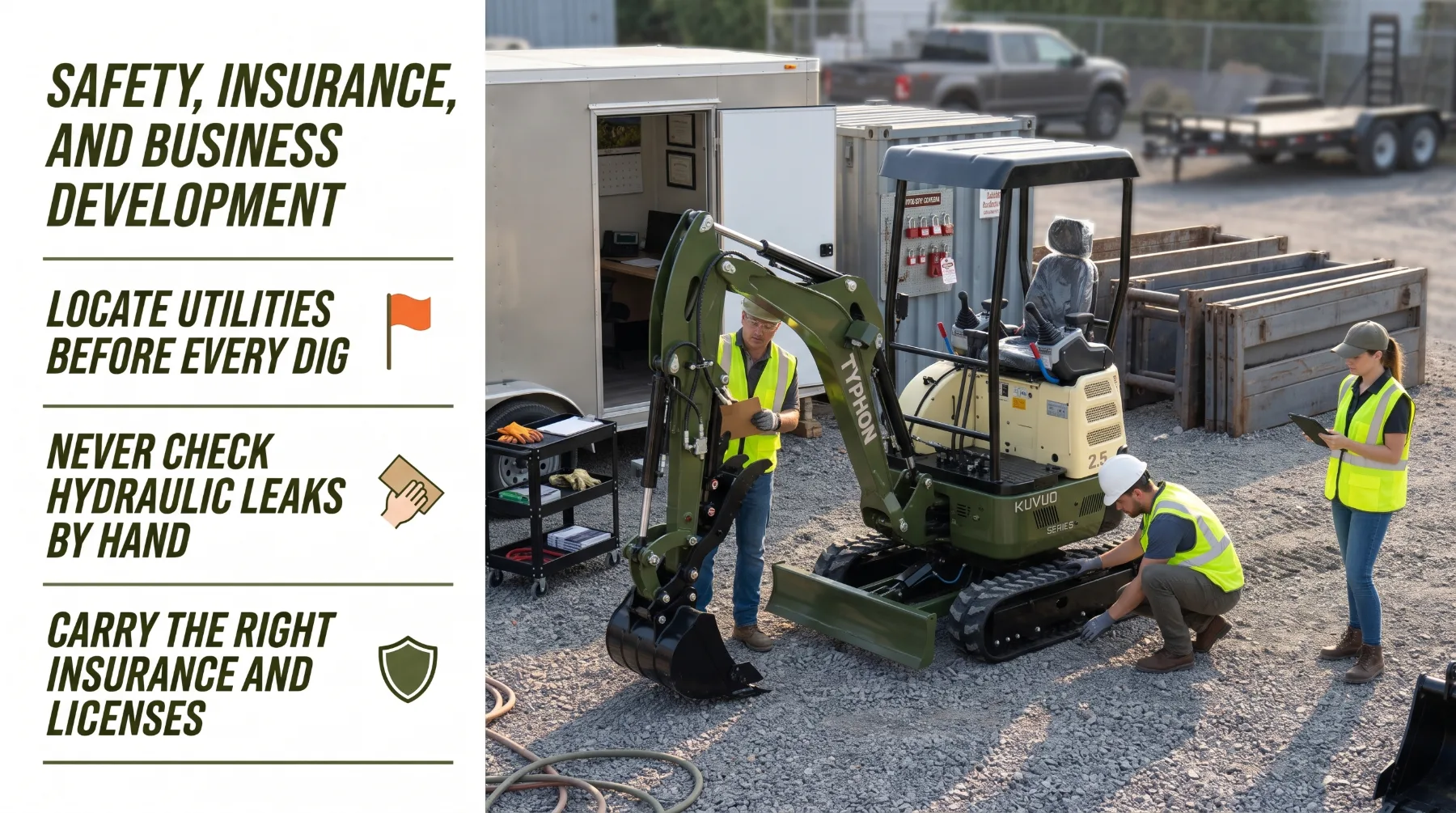
Safety is the foundation of a lasting excavation business. Before any digging begins, contact the local utility locating service, wait for all lines to be marked, and respect the marked areas by hand digging where required near utilities. Private lines, such as sprinkler systems, septic components, and service lines to outbuildings, may not be marked by public utilities, so ask property owners about them. Trenches and excavations present serious collapse hazards. Follow applicable excavation safety rules, use sloping, benching, shoring, or trench boxes where required, keep spoil and equipment back from excavation edges, and never allow anyone to enter an unprotected trench. Keep pedestrians, pets, and other workers outside the machine’s full swing radius.
Daily machine care supports safe operation. Inspect the tracks, undercarriage, pins, cylinders, hoses, fluid levels, seat belt, and pilot control lockout before every shift, and wear the seat belt whenever the machine is in use. Never use your hand to search for a hydraulic leak. Fluid escaping under pressure can penetrate skin and cause an injection injury that requires immediate surgical treatment, even when the wound looks minor. Use a piece of cardboard or wood, wear gloves and eye protection, and keep your face and body out of line with the suspected leak. Before any service beyond the daily walk-around, lower the bucket and blade to the ground, raise the pilot control lockout, shut down the engine, remove the key, relieve hydraulic pressure as the manual directs, and apply a lock and tag. Never work beneath a raised boom or attachment held only by hydraulics.
Proper insurance and licensing protect the business from risks that could otherwise end it. Most excavation contractors need general liability coverage, commercial auto coverage for the tow vehicle and trailer, and equipment coverage for the excavator and attachments. Workers’ compensation coverage is typically required once employees are hired. Many builders and commercial customers ask for proof of insurance before awarding work. Check local and state licensing requirements, permit rules, and any certifications needed for specific services, such as septic installation or utility connections. Operators should be properly trained on the specific machine and on excavation safety.
Business development turns a well-run operation into a growing one. Relationships with builders, landscapers, plumbers, electricians, fence installers, pool companies, and property managers often provide the most dependable flow of work. Ask satisfied customers for reviews and referrals, maintain a simple professional website and online business listings, and use clear vehicle and trailer signage. Before-and-after photos of completed work help customers understand what you offer. Consistent communication, on-time arrivals, and clean jobsites build a reputation that markets the business every day.
Key takeaway: Locate utilities before every job, follow excavation and trench safety rules, inspect the machine and lock it out before service, carry the right insurance and licenses, and grow through trade partnerships and customer referrals.
Conclusion
A compact mini excavator can give a small business a strong entry point into residential and light commercial excavation. Its size opens access to backyards, tight lots, and finished properties where larger machines can’t work, and its versatility supports a wide range of services. Long-term success depends on the decisions made around the machine, including choosing services that match local demand, selecting equipment and attachments suited to real jobs, budgeting for every startup and operating cost, transporting the machine safely, and pricing work accurately with clear agreements.
Business owners who plan carefully before buying equipment reduce their financial risk and build a stronger foundation for growth. Research your market, run the numbers honestly, and invest in safety, insurance, and training from the first day. Build relationships with trades and customers, deliver dependable work, and track your costs so every estimate gets sharper. That disciplined approach turns one compact machine into a trusted excavation business that customers rely on and recommend.
Frequently Asked Questions
What jobs can a small excavation business offer?
Common services include landscaping excavation, drainage installation and regrading, utility trenching, footing and small foundation excavation, fence post and pier holes, septic and sewer support work, pool and patio preparation, and general site preparation. The right mix depends on local demand, the machine’s capabilities, available attachments, and any licensing required for specialized work.
Is a mini excavator suitable for every excavation project?
No. Machine size, digging depth, reach, lifting capacity, stability, and site conditions determine which projects a mini excavator can handle safely. Deep excavations, large rock removal, steep slopes, and heavy lifting may require larger equipment, specialized expertise, or engineered protective systems. Professional operators decline or refer to work that exceeds their machine’s rated capability.
What equipment is needed besides the excavator?
Most operators need a properly rated trailer and tow vehicle, chains and binders for securing the machine, a selection of buckets and attachments, hand tools, ground protection mats, safety equipment, and basic maintenance supplies. Many businesses also invest in a quick coupler, a hydraulic thumb, and a laser level or grade tools as their services expand.
How can a new excavation business find customers?
Relationships with builders, landscapers, plumbers, electricians, fence installers, and property managers often generate the most consistent work. Online business listings, a simple website, customer reviews, vehicle and trailer signage, and referrals from satisfied customers also help. Reliable scheduling, clear communication, and clean jobsites build a reputation that brings in repeat business.