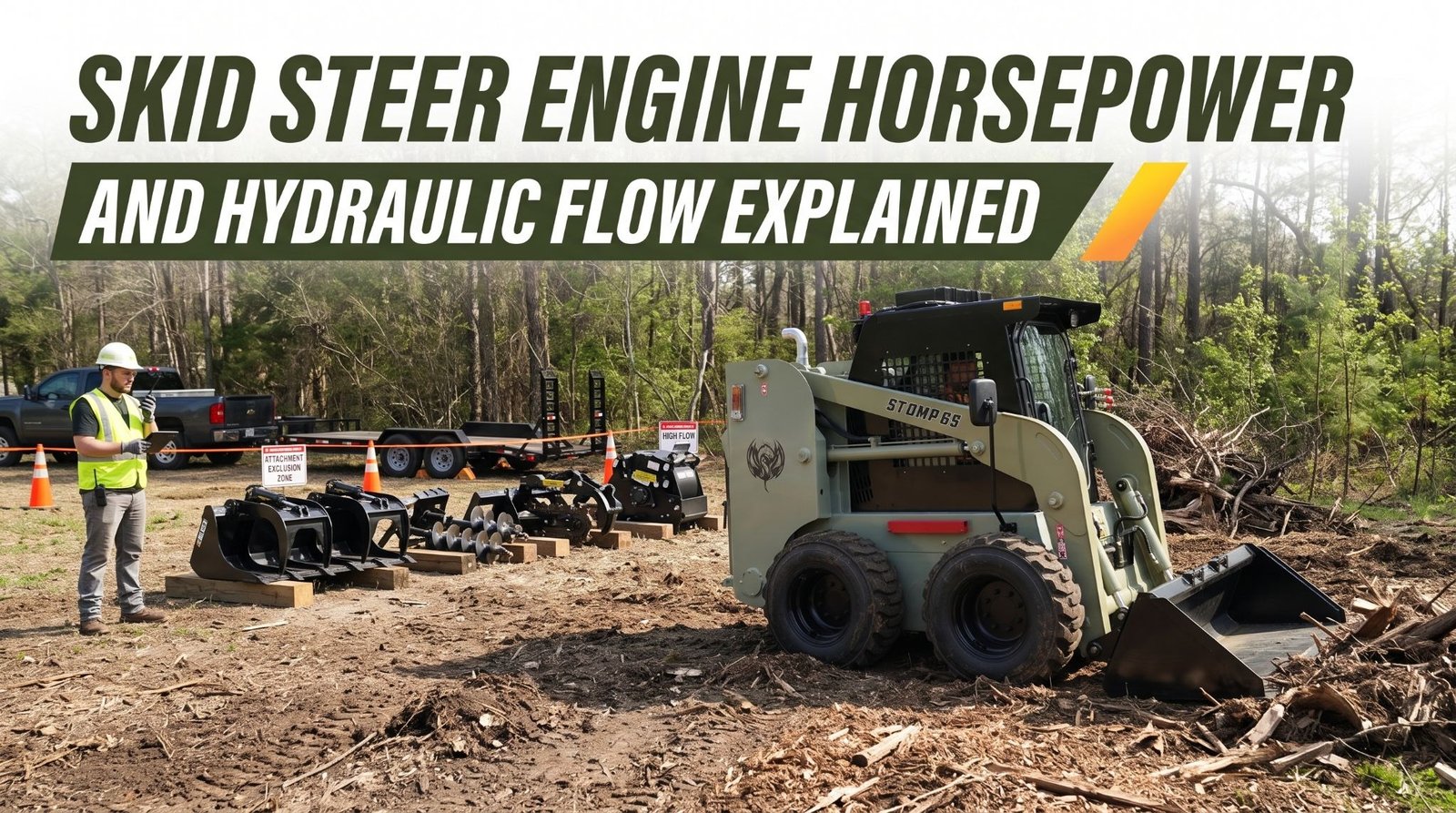
Two skid steers can have similar engine specifications yet deliver very different results under demanding working conditions. One machine may operate a hydraulic attachment efficiently throughout the workday, while another may struggle to maintain attachment speed, experience excessive hydraulic heat, or lose performance under heavy loads. These differences are not necessarily caused by engine output alone. Hydraulic flow, operating pressure, and cooling capacity all influence how effectively a machine powers demanding attachments during extended operation.
Engine horsepower and hydraulic flow are two important skid steer specifications, but they serve different purposes. Horsepower represents the engine’s power output, while hydraulic flow determines how much hydraulic oil the auxiliary system delivers to an attachment and influences its operating speed. Hydraulic pressure affects the force or torque available to perform the work. Buyers should also evaluate auxiliary connections, case drain requirements, and hydraulic cooling capacity when comparing machines. Understanding how these specifications work together helps businesses select equipment that matches their intended applications without paying for capabilities they do not need.
Understand Engine Horsepower
On a skid steer, the engine’s output is split among the hydrostatic drive pumps, the loader and auxiliary hydraulic pump, the cooling fan, the alternator and accessories, and the charge and pilot systems. When an operator pushes into a pile while lifting and running an attachment, all of these draw power at once. The engine must supply the total without stalling or losing too much speed.
Specification sheets may show gross horsepower, net horsepower, or both. Gross horsepower represents engine output under specified test conditions without accounting for all operating accessories. Net horsepower reflects the power available after accounting for components such as the cooling fan, alternator, and other engine-driven equipment. Net horsepower generally provides a more realistic indication of operating performance. When comparing machines, use the same rating method to ensure an accurate comparison.
Torque is another important factor in engine performance. Horsepower describes the rate at which an engine performs work, while torque represents its rotational force. These measurements are related through engine speed. Many diesel engines produce strong torque at lower engine speeds, helping them maintain performance when working under demanding loads. This characteristic can influence how effectively a skid steer handles digging, pushing, and hydraulic attachment work. Reviewing the engine’s torque specifications and performance curve provides a more complete understanding than relying on peak horsepower alone.
Engine horsepower generally increases with machine size, although specifications vary between manufacturers and equipment models. Some machines across different frame categories may have similar horsepower ratings, making engine output alone an unreliable way to compare overall capability. Horsepower does not independently determine lifting capacity, attachment speed, breakout force, or pushing performance. These capabilities also depend on rated operating capacity, hydraulic flow, hydraulic pressure, machine operating weight, and drive system design. Evaluating these specifications together provides a clearer picture of how a skid steer will perform in its intended applications.
Key takeaway: Compare net horsepower and check the torque curve, not just peak output, and remember that horsepower alone doesn’t set lifting capacity, attachment speed, or attachment force.
Understand Standard and High-Flow Hydraulics
The auxiliary hydraulic circuit powers attachments with hydraulic motors or cylinders. Its flow and pressure ratings decide which attachments a skid steer can run and how well it runs them. Most manufacturers offer at least two configurations, and choosing between them is one of the most important decisions a buyer makes.
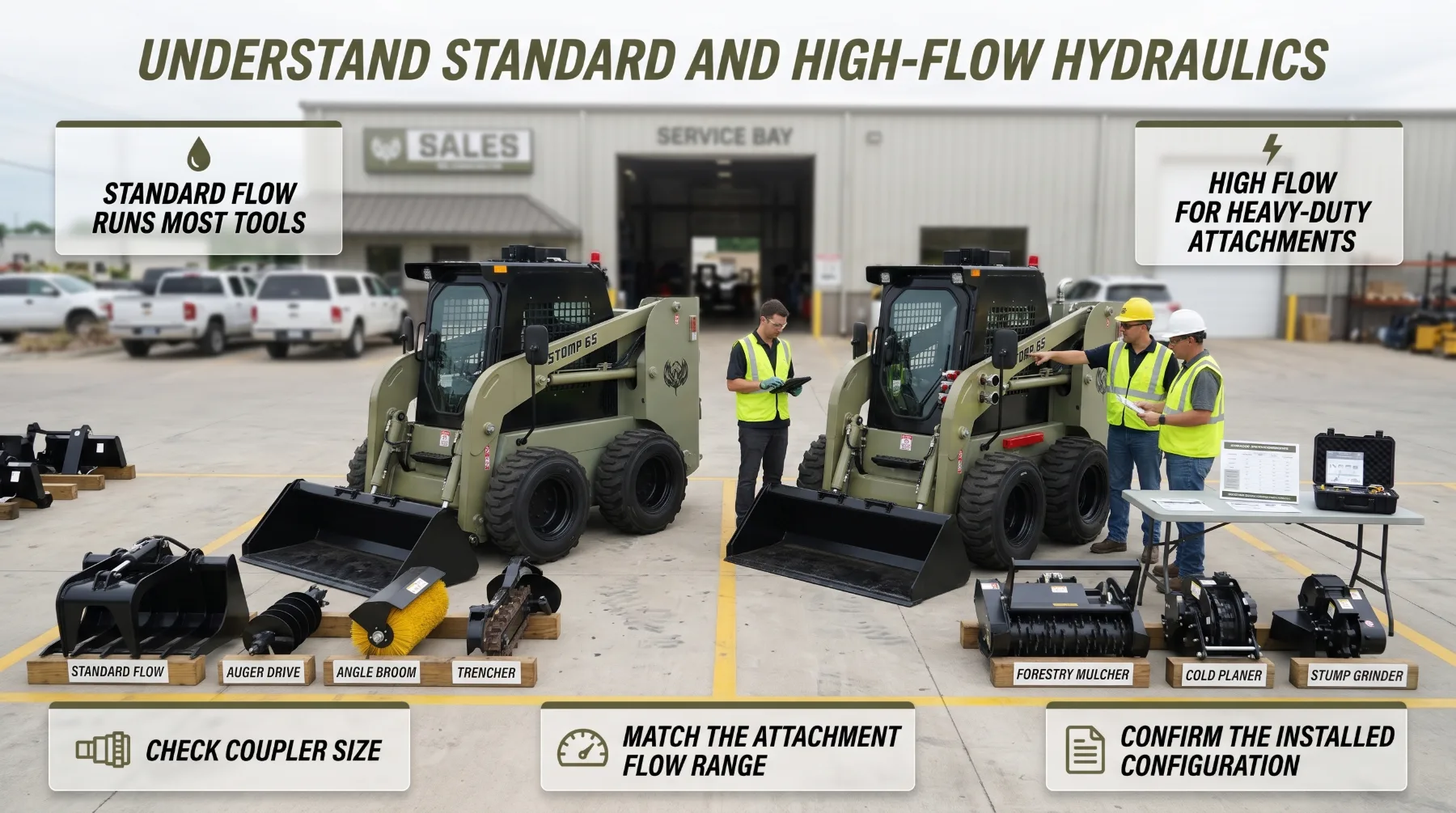
Standard-flow auxiliary hydraulics are commonly available on skid steers and support a wide range of everyday attachments. These systems are suitable for equipment such as grapples, augers, many trenchers, angle brooms, hydraulic breakers, and grading or dozer blades. Their performance depends on the machine’s available hydraulic flow and pressure, as well as the attachment’s operating requirements.
High-flow hydraulic systems are designed for attachments that require greater oil delivery and sustained hydraulic power. They typically include upgraded pumping capacity and larger hydraulic lines to support demanding equipment such as forestry mulchers, cold planers, stump grinders, and rock saws. These systems may also use larger hydraulic couplers to accommodate the increased flow requirements.
High-flow hydraulics are not necessarily included as standard equipment and may be available as an optional configuration. Machines within the same model range can have different auxiliary hydraulic setups depending on their specifications and installed options. Before purchasing, renting, or connecting an attachment, verify the machine’s actual hydraulic configuration through its identification plate, build documentation, or manufacturer or dealer records. Never assume that a skid steer has high-flow capability based on its size or appearance alone.
Key takeaway: Standard flow runs most general-purpose attachments. High flow is designed for heavy continuous-duty tools. Confirm the exact configuration installed on each machine before pairing an attachment.
How Flow and Pressure Shape Attachment Performance
Hydraulic flow refers to the volume of oil delivered through a system over time, usually measured in gallons per minute (GPM). It primarily determines the operating speed of hydraulic attachments. A greater oil supply allows hydraulic motors to rotate faster, provided the motor and attachment are designed to handle the available flow. For cylinder-operated attachments, flow affects how quickly the cylinders extend and retract. This is why attachments such as grapples and angle blades can operate effectively with standard-flow systems, while some demanding rotary attachments require greater hydraulic capacity.
Hydraulic pressure measures the force exerted by oil within the system and is expressed in pounds per square inch (PSI). It determines the force available to operate hydraulic motors and cylinders. In hydraulic motors, pressure contributes to rotational torque, while in cylinders, it determines pushing and pulling force. Flow and pressure serve different purposes, and increasing one does not automatically increase the other. Flow influences operating speed, while pressure determines available force. Both must match the attachment manufacturer’s requirements.
Hydraulic pressure increases as an attachment encounters resistance and is limited by the system’s pressure-relief settings. Relief valve adjustments should never be made simply to increase attachment force. Inspection and testing should be performed by qualified technicians using appropriate equipment and manufacturer-approved procedures. When an attachment stops moving while the machine continues working against the load, the hydraulic system may be operating against its relief valve, generating excessive heat. Reduce the load rather than continuing to hold the controls against resistance.
Hydraulic horsepower represents the combined contribution of flow and pressure to the system’s power output. It helps buyers understand how much hydraulic power a machine can deliver to an attachment. However, the engine must also supply power for pump inefficiencies, drivetrain operation, cooling, and other machine functions. Actual available attachment power is therefore lower than the theoretical hydraulic output.
When comparing skid steers and attachments, review the hydraulic horsepower requirements alongside the specified flow and pressure ranges. A machine may have sufficient overall hydraulic horsepower but still fall outside an attachment’s required operating range. Checking all these specifications together helps ensure compatibility, maintain performance, and reduce unnecessary strain on the hydraulic system.
Key takeaway: Flow sets attachment speed, pressure sets force and torque, and hydraulic horsepower combines both. Match all three to the attachment’s requirements, and never adjust relief settings.
Evaluate Auxiliary Connections and Cooling
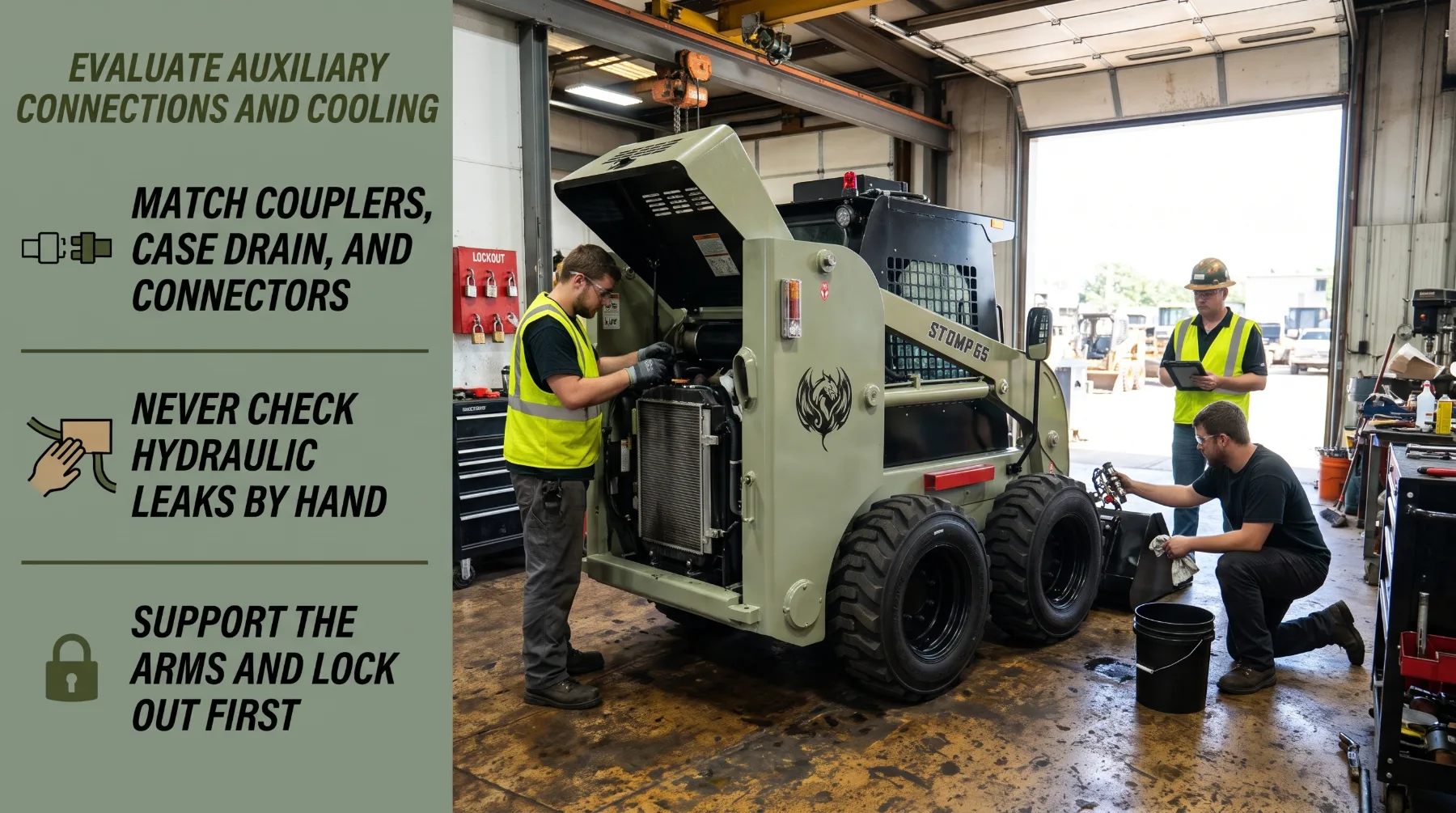
Flow and pressure figures don’t guarantee that an attachment will work on a machine. The connections, drain lines, electrical controls, and cooling capacity must also match. Undersized couplers create heat and back pressure, so confirm the attachment’s coupler size and style match the machine. Many hydraulic motors, especially high-speed piston motors on mulchers and cold planers, require a case drain that returns internal leakage to the tank at very low pressure. If a motor that needs a case drain runs without one, pressure builds inside the housing and can blow out the shaft seal. Always connect the case drain before starting any attachment that requires it. Some attachments are also sensitive to back pressure in the return line, which reduces torque and adds heat. Check the attachment manufacturer’s maximum return pressure against the machine’s specification.
Many attachments use electrical controls for functions such as mulcher hood position, cold planer depth and tilt, or snow blower chute rotation. Confirm that the connector type, pin layout, voltage, and control signals all match the machine. Every hydraulic system also converts some power into heat, and continuous-duty attachments generate a lot of it. High-flow machines often include larger hydraulic oil coolers and reversing fans. Watch for temperature warnings, dropping attachment speed during the shift, or oil that darkens or smells burnt. Clean cooling screens and cores with the engine shut down and locked out, sometimes several times a shift in heavy mulching or sweeping work.
Before connecting any hydraulic attachment, confirm mounting plate compatibility, flow and pressure ranges, hydraulic horsepower requirements, coupler size, case drain and return line needs, electrical connector compatibility, cooling capacity, and any cab guarding the attachment manufacturer requires.
Key takeaway: Match couplers, case drain and return line requirements, electrical connectors, and cooling capacity, not just flow and pressure. Always connect the case drain before starting an attachment that requires one, and clean cooling cores regularly in heavy work.
Service and Safety for Hydraulic Systems
Auxiliary hydraulics operate at high pressure and high temperature. Before connecting or disconnecting attachment hoses, lower the attachment fully to the ground, shut down the engine, relieve auxiliary circuit pressure as the manufacturer instructs, and wipe both coupler halves clean. Connect the case drain first where the manual requires it. Cap open couplers to keep dirt out. Confirm the mounting plate locking pins or levers are fully engaged before lifting or operating.
Inspect hoses, couplers, and fittings for abrasion, cracks, bulges, and leaks during every walk-around. Never use your hand to search for a hydraulic leak. Fluid escaping through a pinhole under pressure can penetrate skin and cause an injection injury. The wound may look minor at first, but it’s a medical emergency that requires immediate surgical treatment. Use a piece of cardboard or wood to locate leaks, wear gloves and eye protection, and keep your face out of line with the suspected leak. If anyone is struck by escaping hydraulic fluid, get emergency medical care at once and tell medical staff it’s a hydraulic injection injury.
Before any inspection, cleaning, or repair, park on firm, level ground, lower the attachment, shut down the engine, remove the key, relieve hydraulic pressure, and apply your personal lock and tag. If the lift arms must stay raised, engage the manufacturer’s approved lift arm support device. Never work beneath, reach under, or lean through raised arms held only by hydraulics, and never bypass the seat bar, operator presence system, or control interlocks. High-power attachments such as mulchers and cold planers can throw debris long distances. Follow the attachment manufacturer’s exclusion zone requirements and use required cab protection. Stop auxiliary flow and let rotating components stop completely before anyone approaches.
Key takeaway: Lower the attachment and relieve pressure before handling couplers, check leaks with cardboard rather than your hands, lock out and use the lift arm support before service, and enforce attachment exclusion zones.
Conclusion
Engine horsepower provides the power needed to operate the machine’s travel system, hydraulic pumps, cooling components, and other accessories, while torque influences how effectively the engine handles demanding workloads. Auxiliary hydraulic flow determines attachment operating speed, whereas pressure determines the available force and motor torque. Hydraulic horsepower combines flow and pressure to indicate the hydraulic power available to an attachment, while accounting for the engine’s additional power demands is essential for maintaining reliable performance.
Attachment compatibility also depends on other hydraulic and electrical connections, including couplers, case drains, return lines, electrical connectors, and cooling capacity. Evaluating all these specifications together helps determine whether a skid steer can operate an attachment efficiently and consistently under its intended working conditions.
Frequently Asked Questions
Does higher horsepower mean stronger skid steer hydraulics?
Not automatically. Horsepower describes engine output, while hydraulic performance depends on pump design, auxiliary flow, pressure, and system configuration. Two machines with similar horsepower can deliver very different auxiliary flow, especially if one has high flow and the other doesn’t. Compare net horsepower, torque, auxiliary flow, pressure, and calculated hydraulic horsepower together, and confirm which hydraulic configuration is installed.
What is the difference between hydraulic flow and pressure?
Flow, measured in gallons per minute, controls speed. It determines how fast a hydraulic motor turns or a cylinder moves. Pressure, measured in pounds per square inch, controls force and torque, determining how hard a motor turns or a cylinder pushes. More flow doesn’t create more force. Demanding attachments usually need adequate flow and pressure, and hydraulic horsepower combines both into a single power figure.
What should buyers check before purchasing a skid steer for attachments?
Compare net horsepower and torque, auxiliary flow and pressure, and calculated hydraulic horsepower against each attachment’s requirements. Then check coupler size and style, case drain and return line requirements, electrical connector compatibility, continuous flow controls, and hydraulic cooling capacity. Confirm attachment weight fits the machine’s rated operating capacity and that the cab meets any guarding requirements the attachment manufacturer specifies.